From Overwhelmed to Organised: The Budgeting Method That Actually Stuck
Updated: 6 days ago
There was a time when my bank balance felt like a monster I was avoiding. I’d tap my card for everything without thinking twice, then feel that panic when I'd eventually check my bank balance. Somehow, even in months where nothing “big” happened, I’d still end up wondering where my money had gone and be shocked by a low balance alert from my bank. I was in the dark and something needed to change. I needed to take back control of my spending. What changed wasn’t my income or finding aperfect system. It was the moment I stopped overcomplicating things and started making my money visible.

I used to think budgeting meant restriction, spreadsheets and tracking every penny - so I avoided it.
Why Most Budgets Don’t Stick
A lot of us don’t fail at budgeting because we’re “bad with money.” We struggle because the methods we try are too restrictive or don't fit out lifestyle. We cut back, track everything and be disciplined. But real life isn’t that perfect. There are birthdays, last-minute plans, emotional spending days, and weeks where everything costs more than expected. So when a budget feels too strict or unrealistic, we give up. Not because we don’t care but because it doesn’t feel sustainable.
The turning point for me was realising: a budget should support your life, not control it.
The Method That Changed Everything
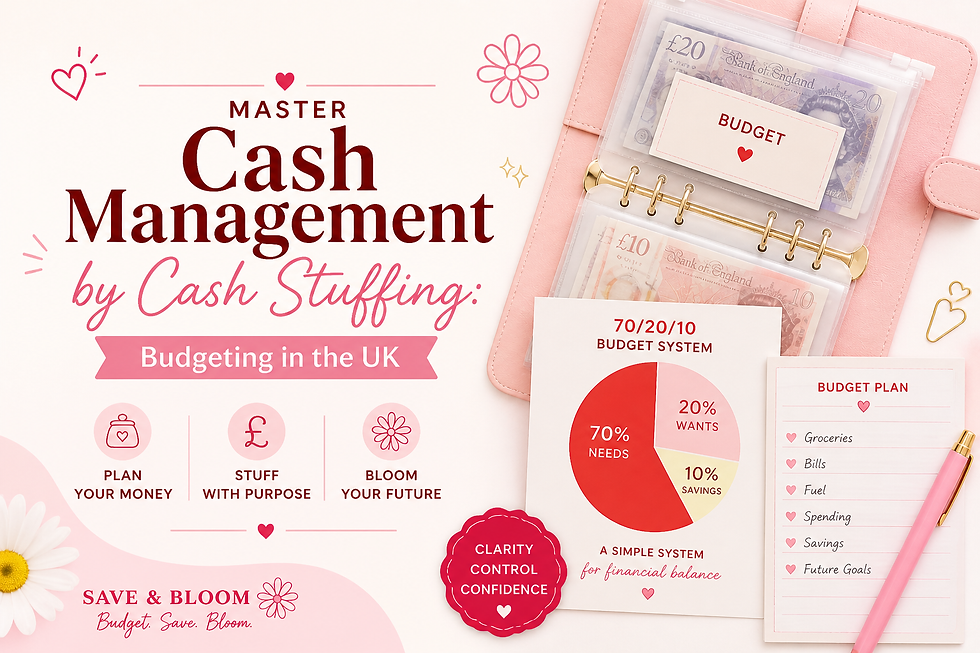
Instead of trying to fix everything at once, I focused on finding a system I could actually keep up with and that is when I discovered cash stuffing. Here’s what made the biggest difference for me:
1. My money was made physical and "real"
Instead of everything sitting invisibly in my bank account and tapping my card not truly feeling like I was spending real money I got physical cash and paid for everything except direct debits with cash*
I started assigning money to categories: Food Shopping, Car Fuel, Socialising, Personal Spending, Self Care, Weekend Treats. Money was give a purpose, and eventually I started taking back control of my spending.
*I found most businesses happily accepted cash and so I paid cash everywhere possible. However, where I wasn't able to pay cash, I would put the cash equivelent in a wallet and then deposited it back in the bank at the end of the week.
2. I stopped being un-realistic with my budget
I used to set un-realistic budgets that didn’t include takeaways or treats for myself. Then I’d overspend and feel like I’d failed. Now? Those things have their own categories. No guilt and no surprises!
3. I creating Sinking Funds
Car repairs, Dentist, Opticians, Christmas, Birthdays, Emergency Fund. New categories for irregular but not the unexpected spending. Creating "sinking funds" for these meant I stopped relying on my overdraft or credit card every time these cropped up in life.
Budgeting ahead for Christmas was the moment everything shifted - I broke free from the exhausting cycle of struggling through January paying off Christmas debt.
The Small Habits That Made a Big Impact
Once I had a simple system in place, a few habits helped everything click:
Assigning money to give it purpose
I seperate my money into categories and name them. Every category has a job. It sounds simple, but it changes how you visualise your budget and how you spend.
Weekly check-ins
I sit down once a week, evaluate my spending for that week and re-set for the next week. Week by week I built confidence and trust in myself.
Monthly check-ins
At the end of each month I adjust my budget based on what I'd learned from the previous month and to plan ahead for events specific events coming up in next: a hair appointment, a birthday or a planned day out.
What Changed
The biggest shift wasn’t just financial it was emotional. I stopped feeling anxious checking my bank account. I stopped guessing if I could afford things and panicking later when I realised I couldn't.
I stopped relying on credit cards. And most importantly, I felt in control again without being restricted or deprived.
How You Can Start Cash Stuffing
If you’re at the beginning of your cash stuffing journey, keep it simple. You don’t need a perfect system, you just need a starting point and you can build slowly from there. Don't overwhelm yourself at the beginning.
Before You Start
Write down one month of spending pay check to pay check. I just noted this down from my banking app, but you can use a printed statement also. The point is not to judge, it is just to understand where your money is going.
Assign categories to each spend e.g. food, car, personal, kids, pets, bills. Write a letter next to each spend or colour code it for these categories. This will help you set up your first budget. How do you know how much to budget for food if you don't know what a typical month looks like? But don't just think of the big food shop - look for small top up shops, lunches, coffees, meals out with friends/family.
Monthly Budget
Set a budget for the month. You can start small with 3-5 categories and add more later if needed.
I started with Food Shopping, Personal Spending, Car Fuel, Socialising and Self Care. Later I added, Weekend Treats and Pets.
Weekly Budget
Divide your monthly spending by week (remember there are some 5 week months).
Keep each fund in a seperate wallet.
Pay in cash and put the change back into that wallet.
At the end of the week evaluate your spending, what is left-over? Which wallets needed more? Which needed less?
Plan for next months budget accordingly.
Example: I was allocating £30 per week for car fuel and £50 for food shopping. Each week, I found I had a lot of leftover money each week in car fuel but was maxing my budget for food shopping. I then allocated £20 per week for car fuel and £60 for food shopping in the next months budget.
Sinking Funds
Set 1-3 sinking funds. Choose something you know is coming up. This could be an irregular bill or something you need to save ahead for e.g. Christmas, Car Service or TV Licence or start an Emergency Fund. I started with Christmas and Car Maintenance (MoT, Service, Insurance, Repairs).
Create a wallet for each sinking fund and store in a budget binder.
Allocated a portion of your wages to these sinking funds, withdraw the cash and store it in the wallet. Even a small amount will soon add up. When you develop confidence you can add more sinking funds. The goal isn’t to do everything at once. It’s to build something that feels manageable.
Add any leftover money from your monthly spending categories to these sinking funds.
You can start a penny savings challenge or have a savings tin/bottle/jar for any loose change. This money once built up can be added to your sinking funds.
Save the pennies to save the pounds!
Example: I had £26.28p left at the end of my weekly budget. I allocated £20 to my Christmas sinking fund, £5 to my TV licence sinking fund and £1.28p to a penny saver challenge.

A Final Thought
If your money has been feeling chaotic, it doesn’t mean you’ve failed - it just means you haven’t found a system that works for you yet.
Clarity changes everything. When you can see where your money is going, you can start making decisions that feel intentional.
If you’re ready to make budgeting feel simpler (and a lot less overwhelming) cash stuffing can help turn your finances into something you can actually see and manage - one category at a time.
You don’t need to be perfect, you just need to start.
Comments